The Battery in Your Car Key Remote Could Land Your Child in the ER
An important reminder:
This post and anything on this website is for educational purposes only. It should not be used as medical advice or delay seeking medical attention. Every child is different and has different needs. Your child’s provider can help you figure out the best management plan for your specific situation.
You've childproofed the cabinets. You've covered the outlets. You've got the baby gate at the top of the stairs. But there's a good chance there's something sitting in your junk drawer, your TV remote, and your child's favorite light-up toy that most parents have never thought twice about — and it's one of the more serious hazards in a home with young children.
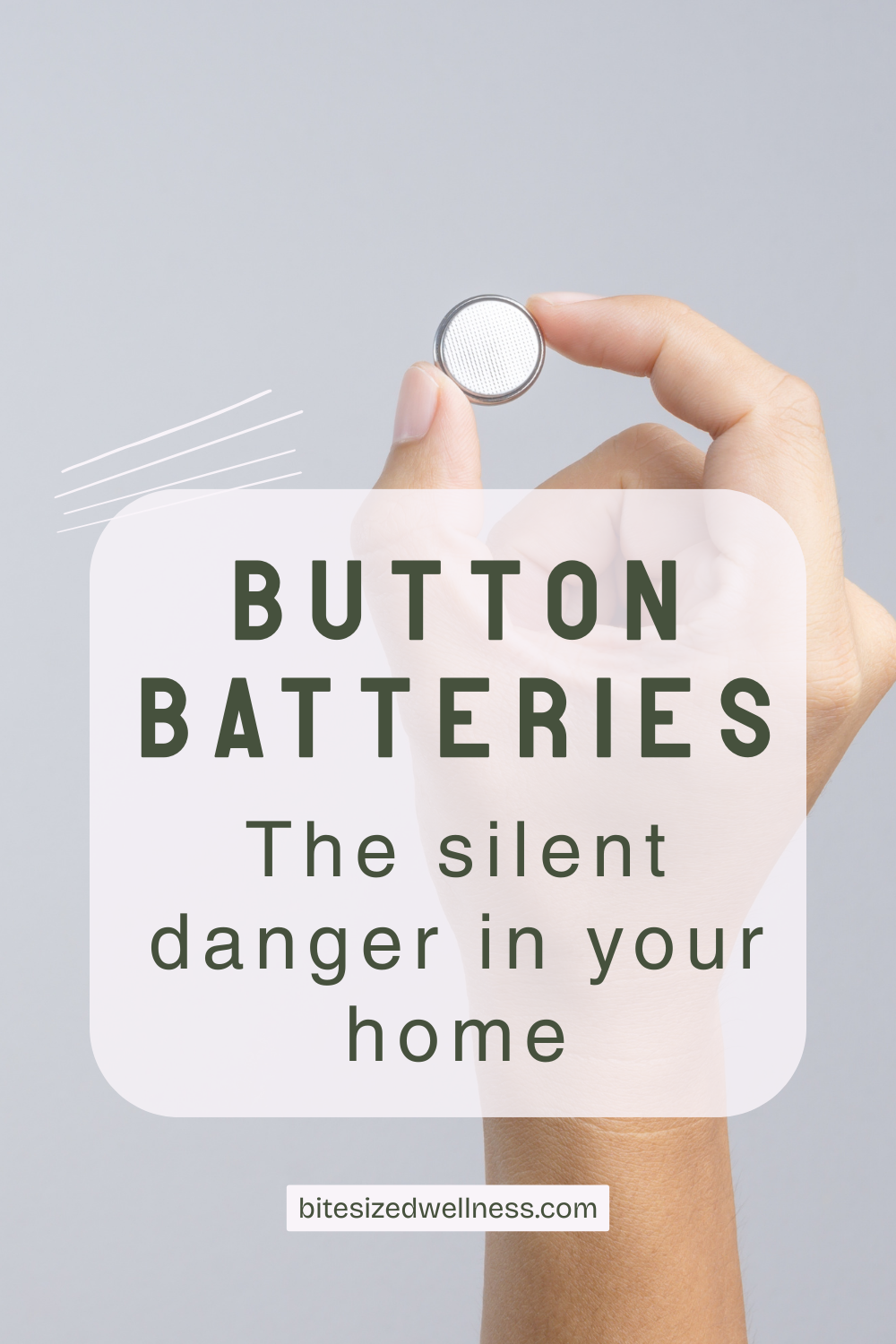
Button batteries. Those small, flat, coin-shaped cells that power half the devices in your house.
This post isn't meant to send you into a spiral. It's meant to give you the kind of information that actually helps — the stuff that lets you take a few simple steps today and know exactly what to do if you ever need it.
What makes them different from regular batteries
Most household hazards are dangerous because of what they are — sharp, hot, heavy, or toxic, choking hazard, etc... Button batteries are different. The danger isn't really about the battery itself. It's about what happens when that battery meets the moisture inside a small body.
When a button battery gets lodged somewhere in the digestive tract — most commonly the esophagus — it generates a low-level electrical current. That current triggers a chemical reaction in the surrounding tissue. The result is a slow internal burn that keeps going for as long as the battery stays in place. It doesn't require the battery to be new or fully charged. A battery that stopped powering your remote weeks ago still has enough residual energy to cause this reaction.
That's the part most parents don't know. "Dead" does not mean safe.
Why toddlers and babies are most at risk
Children in the baby and toddler years explore the world with their mouths. That's developmentally normal and expected. But it also means that anything small enough to pick up is a potential swallowing hazard — and button batteries are exactly the right size and shape to be appealing.
They're shiny, smooth, and easy to grab. And they turn up in places we don't always think to check: inside greeting cards with music or lights, in the key fob you toss on the counter, in the bathroom scale, in small children's toys, in remote controls with loose battery doors, in digital watches, and in hearing aids.
Loose batteries — ones that have been replaced and set aside — are especially risky because they're no longer inside a device and can roll anywhere.
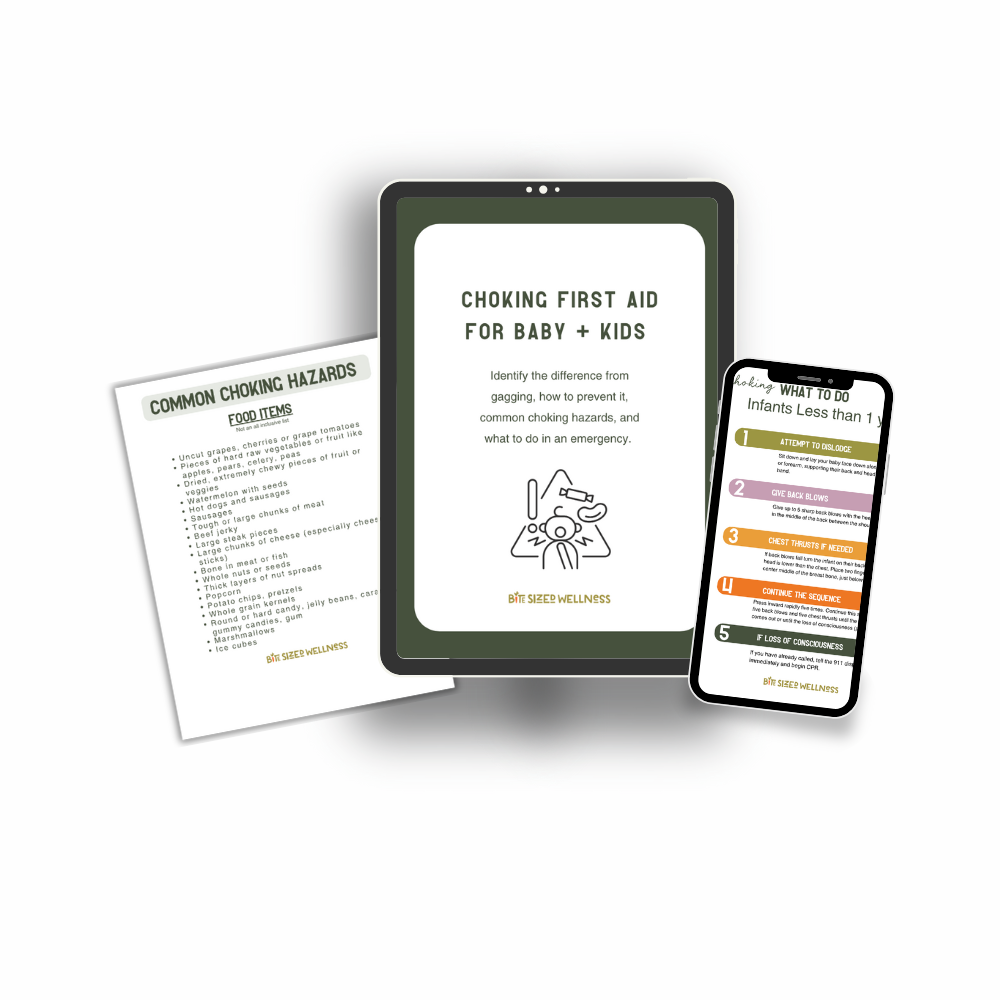
is a free downloadable resource that covers how to identify choking, common choking hazards, how to modify your environment, and what to do step by step in a choking emergency. SAVE IT and hang it on the refrigerator.
The thing that makes Button Batteris particularly tricky
Here's what makes button battery ingestion genuinely hard to catch: children often have no symptoms at all, at least not right away. When symptoms do show up, they can look like any number of other common childhood illnesses — a mild cough, some fussiness, not wanting to eat. Nothing that automatically signals an emergency.
By the time more obvious signs appear, significant time may have already passed.
This is why the general guidance from the American Academy of Pediatrics is so important to understand: you do not need to have witnessed your child swallow a battery to seek emergency care. Suspicion alone is a good enough reason to go.
Symptoms that can appear — though many children will have none — include:
Difficulty or discomfort when swallowing
Drooling more than usual
Decreased interest in eating
Noisy or labored breathing
A cough that comes on suddenly
Vomiting
Chest pain or discomfort
Blood in saliva
If your child is showing any of these and you have any reason to think a button battery might be involved, treat it as an emergency.
This is a medical emergency — here's what to do
If you believe your child has swallowed a button battery, call 911 or go to the nearest emergency room immediately. Do not wait to see if symptoms develop. Do not try to make your child vomit. Do not give food or drinks.
The one exception to the no food or drink rule is honey , and only for children who are at least 12 months old. The AAP recommends that parents give 2 teaspoons of honey every 10 minutes while on the way to the emergency room, up to 6 doses total. The idea is that honey may help coat the battery and slow the reaction in the tissue around it. It is not a treatment. It does not replace emergency care. And it should never be given to babies under one year old due to the risk of infant botulism.
One more thing worth repeating: do not delay leaving for the hospital to look for honey. If you have it, great. If you don't, go.
National Battery Ingestion Hotline: 1-800-498-8666
Simple prevention steps that make a real difference
You can significantly reduce the risk in your home without overhauling everything. A few targeted steps go a long way:
Check every battery compartment. A lot of devices — especially inexpensive children's toys and remote controls — have battery doors that come open easily. Go through your home and use a small piece of tape to secure any compartment that doesn't require a tool or deliberate effort to open.
Keep spare batteries out of reach. Loose batteries waiting to be used are just as dangerous as the ones inside a device. Store them in a place a toddler genuinely cannot access — not just on a high shelf, but in a closed container or locked drawer.
Dispose of used batteries carefully. Wrapping a used battery in a few layers of tape before throwing it away or recycling it keeps it from looking interesting and reduces the chance of accidental contact.
Think beyond the obvious. Musical greeting cards, keychain accessories, and small decorative items often contain button batteries and don't look like the kind of thing you'd childproof. Walk through your home with fresh eyes and think about anything that lights up, plays music, or has a small round battery you might have forgotten about.
When in doubt, go
If you're not sure whether your child swallowed something — a battery or anything else — the right move is always to seek care. An unnecessary ER visit is far better than the alternative. Trust your gut.
Want to feel even more prepared?
Knowing about button batteries is a great start. But real confidence comes from having the full picture — knowing what to do in a choking emergency, knowing infant and child CPR, and understanding the difference between a situation that needs 911 and one that can wait.
At Bite Sized Wellness, that's exactly what we help parents build.
The Choking First Aid for Babies + Kids guide is a free downloadable resource that covers how to identify choking, common choking hazards, how to modify your environment, and what to do step by step in a choking emergency. SAVE IT and hang it on the refrigerator.
Ready to go deeper: The Baby & Child CPR + First Aid + Safety classis a hands-on training for parents, grandparents, and caregivers who want to feel genuinely prepared — not just informed. Available in St. Louis and as private sessions.
Just want to stay in the loop: Join the Bite Sized Bits Newsletter below for practical pediatric tips delivered to your inbox — no overwhelm, just the things that actually matter.
-
Medical/General: The content, information, opinions, and suggestions listed here have been created with typically developing children and babies in mind. The information here is generalized for a broad audience. The information here should by no means be used as a substitute for medical advice or for any circumstance be used in place of emergency services. Your child is an individual and may have needs or considerations beyond generally accepted practices. If your child has underlying medical or developmental differences, including but not limited to prematurity, developmental delay, sensory processing differences, gastrointestinal differences, cardiopulmonary disease processes, or neurological differences, we strongly recommend you discuss your child's plan with the child's doctor, health care provider. By accessing this site and the information in it, you acknowledge and agree that you are accepting responsibility for your child’s health and well-being. By using and accepting the information on this site, the author (Cierra Crowley) is not responsible for any adverse effects or consequences resulting from the use of any suggestions discussed. It is important to talk to your child’s pediatrician or medical provider to start anything new or make any changes.
Affiliation: this page contains affiliate links from which I can earn small commissions (at no additional cost to you).
-
American Academy of Pediatrics Council on Injury, Violence and Poison Prevention & Section on Otolaryngology, Head & Neck Surgery. (2021). How small batteries can become dangerous to children. HealthyChildren.org. https://www.healthychildren.org/English/safety-prevention/at-home/Pages/Button-Battery-Injuries-in-Children-A-Growing-Risk.aspx
Chandler, M. D., Ilyas, K., Jatana, K. R., et al. (2022). Pediatric battery-related emergency department visits in the United States, 2010–2019. Pediatrics, 150(3), e2022056709. https://doi.org/10.1542/peds.2022-056709
American Academy of Pediatrics. (2021). Button battery ingestion: What do you do? Pediatrics, 147(3 Meeting Abstract), 854. https://publications.aap.org/pediatrics/article-abstract/147/3_MeetingAbstract/854/5803/Button-Battery-Ingestion-What-Do-You-Do
Mahesh, A., Keogh, I., & Majeed, K. (2026). Button battery ingestion in children is potentially fatal: assessing and raising awareness of a decades old problem. The Journal of laryngology and otology, 140(2), 149–153. https://doi.org/10.1017/S0022215125103782