Best Bug Repellents for Babies and Kids
An important reminder:
This post and anything on this website is for educational purposes only. It should not be used as medical advice or in place of or to delay seeking medical attention. Every child is different and has different needs. Your child’s provider can help you figure out the best management plan for your specific situation.
Summer means outdoor adventures, getting our kids (and ourselves) outside more, and enjoying all the activities that come with nicer weather. Which also means more exposure to bugs and potential bug bites and stings. Most bites and stings are easy to treat at home. Biting insects aren't just annoying — they can transmit serious infections like Lyme disease and West Nile virus. The good news: choosing the right repellent and using it correctly gives your family real, reliable protection.
THE QUICK VERSION
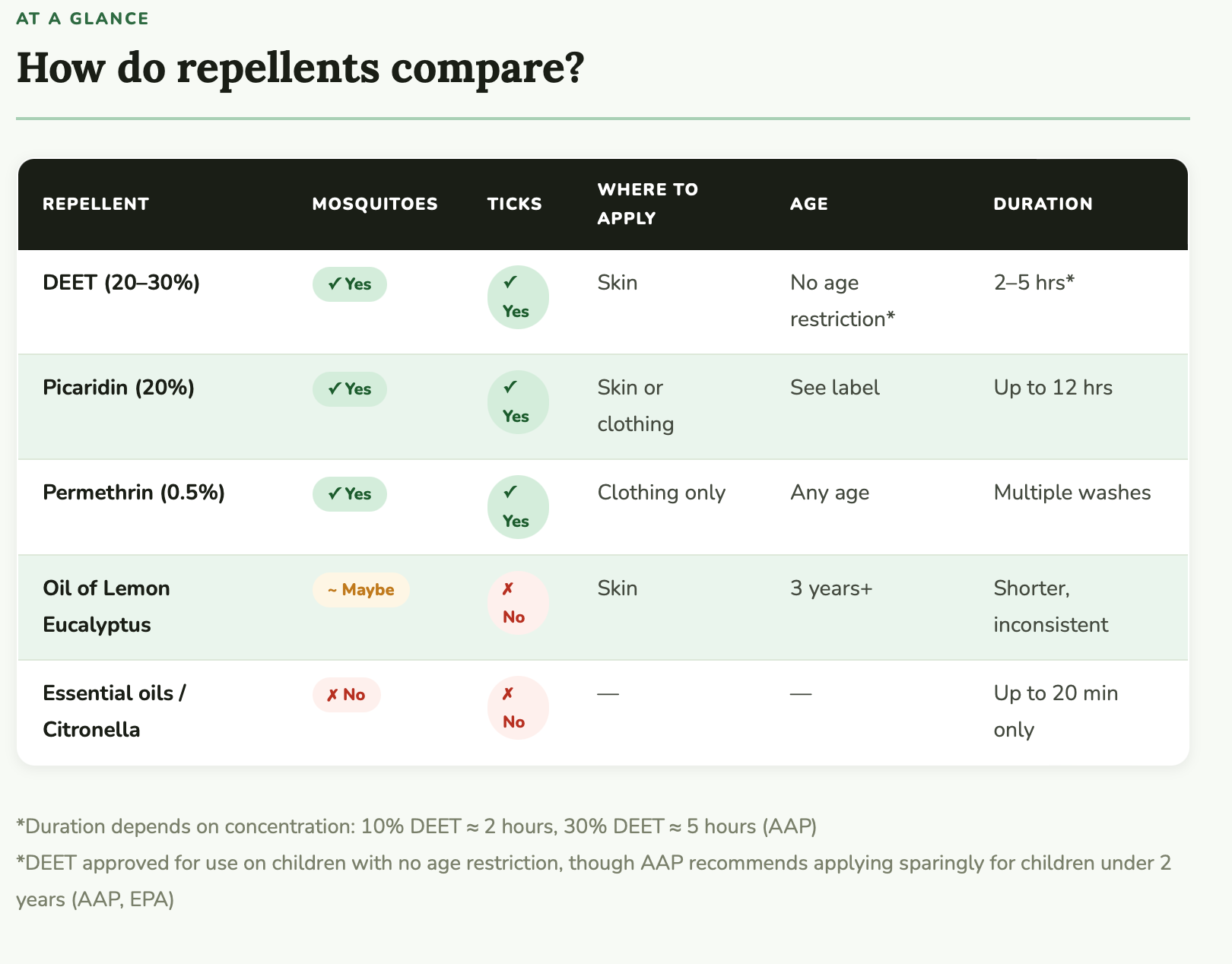
Choose a product containing DEET (20–30%) or Picaridin (20%) — both are safe, effective, and well-studied
Both DEET and Picaridin are safe for babies 2 months and older
Add Permethrin on clothing for extra tick protection — but never on skin
Natural and essential oil-based repellents — not effective enough and not as well studied
Don't use combination sunscreen/insect repellent products
Apply sunscreen underneath bug repellent — not on top

Your go-to resource for what to keep on hand to confidently care for your baby, child, and whole family through sick days, emergencis and every day care!
Recommended REpellents
The three options that actually work and are recommended by the American Academy of Pediatrics (AAP) and Environmental Protection Agency (EAP).
When it comes to bug repellent, effective and safe are not opposites — they go together. The following three options are recommended and backed by solid safety data. Pick a product containing one of these active ingredients and you're in good shape. Along with using non-repellent options for most protection.
Picaridin
APPLY TO SKIN
Highly effective against mosquitoes and ticks
Safe and well-studied; more widely used outside the US
Choose 20% concentration — provides up to 12 hours of protection
Leaves less residue on clothing than DEET
Safe for babies 2 months and older
Can be applied to skin or clothing
May cause skin irritation in some — switch to DEET if this happens
DEET
APPLY TO SKIN
Highly effective against mosquitoes and ticks
The most thoroughly studied repellent available
10% DEET provides about 2 hours protection, 30% DEET provides about 5 hours protection (AAP)
Below 20% may not provide enough tick protection
Safe for babies 2 months and older; apply sparingly for children under 2 years (AAP)
Toxicity is very rare and usually from ingestion, not skin contact
Can damage synthetic fabrics and plastics (e.g., eyeglasses)
Permethrin
APPLY TO CLOTHING
Highly effective tick repellent — also works against mosquitoes
Spray on clothing, shoes, socks, and camping gear
Do not apply to skin — rapidly degraded on skin contact
Let clothing dry completely before wearing
Protection can last through multiple washes
Wash treated clothing separately
Do not spray around cats — toxic to cats when wet
Use as an added layer, not a replacement for skin repellent
TIP: You don't need to choose between Picaridin and DEET. If you find one causes skin irritation, switch to the other. The most important thing is picking one of these two, in the right concentration, and using it.
APPLICATION
How to use repellent correctly.
Choosing the right repellent is only half the job — how you apply it matters just as much.
Apply sunscreen first then repellent
Apply sunscreen underneath bug repellent the first time you put them both on. After that, sunscreen goes on top since it needs to be reapplied every 2 hours. This is also why you should never use combination sunscreen/repellent products — you'd end up reapplying repellent far more often than needed.
APply only to exposed skin
Do not apply under clothing.
Do not apply to skin covered by clothing.
Avoid areas that are sunburned or have rashes — repellent is more easily absorbed through damaged skin.
Apply just enough to cover exposed skin; heavy application is unnecessary and doesn't add protection.
Keep it away from eyes, mouths, and hands
Do not apply near eyes and mouth, and apply sparingly around ears (EPA).
Do not allow children to handle repellent products, and do not apply to children's hands (EPA).
When using on children, apply to your own hands first and then put it on the child (EPA).
When using sprays, do not spray directly into face; spray on hands first and then apply to face (EPA).
Do not spray in enclosed areas (EPA).
Re-Application
Duration varies by concentration:
10% DEET provides about 2 hours,
30% DEET about 5 hours; 20%
Picaridin provides up to 12 hours (AAP).
Reapply as directed on the packaging and label instructions.
Don't overuse the products, but be sure to apply the amount of repellent indicated by the label.
If you don't follow the label directions, the product may not be as effective as you expect. The label on the insect repellent product is your guide to using these products safely and effectively
Wash treated clothing before wearing it again and reapply repellent the next day.
Wash it off when coming inside
After returning indoors, wash treated skin and clothes with soap and water (EPA).. For children: after returning indoors, wash your child's treated skin and clothes with soap and water or give them a bath (EPA).
Check for ticks at the end of the day — even if you used repellent
Repellent significantly reduces tick encounters but is not 100% foolproof. Do a tick check every evening, especially after time in wooded or grassy areas. Ticks often hide behind ears, along the hairline, behind the knees, and in the groin area.
What about Babies?
This is one of the most common questions parents have — myself included when mine were tiny babies!
When it comes to insect repellents for babies:
DEET is approved for use on children with no age restriction (EPA). However, for children under 2 years old, their skin may be different than older children or adults, and AAP recommends applying DEET sparingly when needed (AAP). Parents should weigh the risks of exposure to potentially serious illness spread by insects against the possible risk of absorbing chemicals into the body (AAP).
Newborns and very young infants
Parents of newborns and premature infants should be especially cautious when deciding whether to apply DEET or other chemicals on their child's skin (AAP).
For very young babies, mosquito netting is the safest option — especially over strollers and carriers. Make sure any netting allows airflow and prevents overheating, and that you can still clearly see your baby at all times.
Here is a baby mosquito net you can check out CLICK HERE
Additionally, you could consider mosquito repellent stickers like these. Just don’t rely on them for your only source of insect repellent protection, as they are citronella bases (see below on that) so they may not provide wide protection.
What about Natural Repellents?
It's natural to want a "natural" option for your child. I choose natural and clean as often as I can in our home. We try to choose lower “tox” options but here is something to consider.
Essential oils — including lemongrass, cinnamon, soybean, peppermint, clove, and citronella — have not been studied as thoroughly for safety as DEET or Picaridin. Evidence that they protect against bugs is minimal; one study found that, if present, mosquito protection lasted only up to 20 minutes. They can also cause skin reactions. Essential oils are not regulated. So use your best judgment, be mindful of essential oil concentrations and which ones are a HARD STOP in using with kids, and remember that “natural” doesn’t always mean safer.
Oil of Lemon Eucalyptus
Oil of Lemon Eucalyptus is a synthetic version of a chemical from the lemon eucalyptus plant — it is not an essential oil. Some studies suggest it may be effective against mosquitoes and gnats, but studies show inconsistent and lower efficacy compared to DEET or Picaridin, and likely shorter duration. Do not use products containing oil of lemon eucalyptus or para-menthane-diol (PMD) on children younger than 3 years old (AAP)
Citronella Candles
Citronella is not considered as effective or long-lasting as DEET for mosquitoes and is not effective as a stand-alone repellent for kids. Citronella candles are fine as a secondary, backup layer if you are in your yard, but shouldn’t be relied on as a primary repellent. Another note about citronella candles and open flames: be mindful of placement around young kids so that they cannot reach them and burn themselves or spill the wax on themselves.
Natural and other alternative repellents may be okay if there is no concern about getting a serious insect-borne illness. If there is a health concern—such as for Lyme disease in an area known to have ticks—DEET, picaridin or another approved effective product should be used.
Tips for all babies and kids
Do not allow children to handle repellent products, and do not apply to children's hands
When using on children, apply to your own hands first and then put it on the child
Bright colors, flowery prints, and scented soaps and shampoos are more attractive to bugs.
Dressing babies and young children in light, plain-colored clothing can help reduce bites on top of repellent use.
Before you head outside checklist
Everytime Checklist
Choose EPA-registered DEET (10–30%) or Picaridin (20%) for skin — DEET approved for children with no age restriction, apply sparingly for children under 2 years (AAP, EPA)
Apply sunscreen first, then repellent on top
Use spray repellents in open areas to avoid breathing them in.
Use mosquito netting over baby carriers or strollers in areas where your baby may be exposed to insects.
Apply only to exposed skin and clothing — not under clothing, do not apply to children's hands, not near eyes or mouth (EPA)
For children: do not allow children to handle products; apply to your own hands first, then put it on the child (EPA)
Dress in light-colored, long-sleeved clothing when possible — especially in wooded or grassy areas
Add Permethrin to shoes, socks, and clothing for extra tick protection
Apply according to label directions — duration varies by concentration (EPA)
Wash hands before eating; wash repellent off skin with soap and water when coming inside (EPA)
Do a tick check at the end of every day in tick season — even with repellent
Skip combination sunscreen/repellent products
Skip natural, essential oil-based repellents — they don't work well enough
DO NOT USE Repellent candles if your child is at risk of breathing problems from fumes.
DO NOT USE Insect repellent directly on your child's face. Instead, spray a little on your hands first and then rub it on your child's face. Avoid the eyes and mouth.
DO NOT USE Insect repellent on cuts, wounds or irritated skin.
To learn more about bug bites and stings and how to care for them in kids, head to our blog “Bugs, Bites & Stings: First Aid for Babies and Kids”.
Find our Ready to Use First Aid Kit Check List below for everything you need to keep on hand to confidently care for babies and kids through emergencies and sick days!
And to make it even easier, I put together an easy to purchase DIY kit for yourself here —> DIY FIRST AID KIT LINKS
Your go-to resource for what to keep on hand to confidently care for your baby, child, and whole family through sick days, emergencies, and every day care!
Want to feel even more prepared?
Knowing how to prevent bug bites and provide basic first aid is a huge step in your parenting confidence! But real confidence comes from having the full picture and knowing what to do in a breathing or choking emergency, knowing infant and child CPR, how to respond to fevers and other illnesses, and understanding the difference between a situation that needs 911 and one that can wait.
At Bite Sized Peds that is exactly what we help parents build.
Our Baby & Child CPR + First Aid + Safety class is a hands-on training for parents, grandparents, and caregivers who want to feel genuinely prepared — not just informed. Available in person community sessions, private sessions or private virtual sessions.
We give you the confidence to know what is an emergency, what can you (YES YOU) can manage at home, how to do so, and when to seek care.
We cover everything from
Infant Choking + CPR
Child CPR
Breathing Emergencies
Fevers
Dehydration
Head bumps
Bleeding
Burns
Ingestions
Seizures
Allergies
and so much more!
Just want to stay in the loop: Join the Bite Sized Bits Newsletter below for practical pediatric tips delivered to your inbox — no overwhelm, just the things that actually matter.
-
Medical/General: The content, information, opinions, and suggestions listed here have been created with typically developing children and babies in mind. The information here is generalized for a broad audience. The information here should by no means be used as a substitute for medical advice or for any circumstance be used in place of emergency services. Your child is an individual and may have needs or considerations beyond generally accepted practices. If your child has underlying medical or developmental differences, including but not limited to prematurity, developmental delay, sensory processing differences, gastrointestinal differences, cardiopulmonary disease processes, or neurological differences, we strongly recommend you discuss your child's plan with the child's doctor, health care provider. By accessing this site and the information in it, you acknowledge and agree that you are accepting responsibility for your child’s health and well-being. By using and accepting the information on this site, the author (Cierra Crowley) is not responsible for any adverse effects or consequences resulting from the use of any suggestions discussed. It is important to talk to your child’s pediatrician or medical provider to start anything new or make any changes.
Affiliation: this page contains affiliate links from which I can earn small commissions (at no additional cost to you).
-
American Academy of Pediatrics. (2024, June 21). How to Choose an Insect Repellent for Your Child. HealthyChildren.org. https://www.healthychildren.org/English/safety-prevention/at-play/Pages/Insect-Repellents.aspx
U.S. Environmental Protection Agency. (2025, November 10). Using Insect Repellents Safely and Effectively. https://www.epa.gov/insect-repellents/using-insect-repellents-safely-and-effectively
Schmitt, B. D. (2026). Pediatric telephone protocols: Office version (Copyright 1994–2026). Schmitt Pediatric Guidelines, LLC. ·